
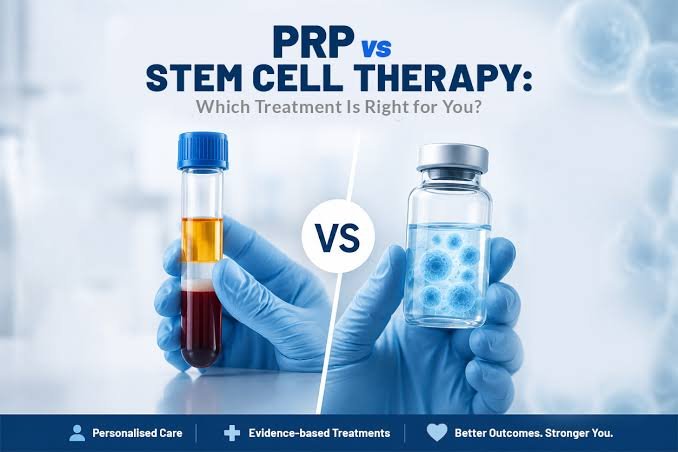
PRP vs Stem Cell Therapy: Which Is Right for You?
A Complete Guide to Regenerative Medicine for Joint Pain, Arthritis, and Sports Injuries
Looking for an Alternative to Surgery?
Living with persistent knee pain, shoulder pain, or arthritis can be frustrating. Simple activities like climbing stairs, getting out of a chair, walking long distances, or playing your favorite sport may become increasingly difficult over time.
For many people, the first treatment options include pain medications, physiotherapy, or steroid injections. While these approaches can provide symptom relief, they may not always address the underlying condition affecting the joint. As regenerative medicine has become more widely discussed, many patients now ask whether PRP is better than stem cell therapy, which treatment lasts longer, and whether regenerative medicine can help them avoid surgery.
The answer isn't as simple as choosing one treatment over another. PRP therapy and stem cell-based regenerative treatments are both designed to support the body's natural healing processes, but they work differently and are used for different clinical situations. The right choice depends on your diagnosis, severity of joint damage, age, activity level, overall health, imaging findings, and treatment goals — understood together with your orthopedic specialist.
What Is Regenerative Medicine?
Traditional orthopedic treatments often focus on relieving symptoms such as pain and inflammation. Regenerative medicine takes a different approach — instead of simply masking symptoms, it aims to create an environment that may support the body's own healing and repair mechanisms in carefully selected patients. Rather than replacing damaged tissue, these therapies seek to preserve joint function, improve mobility, and support long-term musculoskeletal health where appropriate.
Today, regenerative orthopedics includes several biologic treatments:
- Platelet-Rich Plasma (PRP)
- Bone Marrow Aspirate Concentrate (BMAC)
- Stromal Vascular Fraction (SVF)
- Hyaluronic Acid (Viscosupplementation)
- Combination biologic therapies in selected cases
Each treatment has unique characteristics, indications, and limitations. There is no universal solution that works for every patient.
Understanding How Joints Heal
Healthy joints are constantly undergoing repair. Cartilage, ligaments, tendons, muscles, and bone all respond to injury through a complex biological healing process — increasing blood flow, activating platelets, releasing growth factors, recruiting repair cells, reducing damaged tissue, and beginning tissue remodeling.
In younger individuals, this process often occurs efficiently. With aging, arthritis, repetitive stress, metabolic conditions, or chronic inflammation, the body's healing response may become less effective — one reason recovery from joint injuries may take longer with age. Regenerative medicine seeks to support these natural biological processes rather than replacing them.
What Is PRP Therapy?
Platelet-Rich Plasma (PRP) therapy uses a concentrated portion of your own blood. A small blood sample is collected and processed using a centrifuge to separate and concentrate platelets. Platelets are best known for helping blood clot after an injury, but they also contain naturally occurring growth factors involved in tissue repair. Once prepared, the concentrated PRP is injected into the affected area. Because PRP is derived from your own blood, it reduces concerns about compatibility and allergic reactions.
Rather than acting like a painkiller, PRP is intended to support the body's natural healing response. Platelets release signaling molecules and growth factors that play roles in tissue healing, blood vessel formation, cellular signaling, collagen production, and inflammation regulation. It is not an instant cure, and responses vary from person to person.
Conditions Where PRP May Be Considered
- Knee osteoarthritis (early to moderate, after orthopedic evaluation)
- Sports injuries — ligament sprains, muscle injuries, tendon injuries
- Tennis elbow that hasn't improved with conservative care
- Chronic plantar fasciitis (heel pain)
- Rotator cuff tendinopathy
Advantages of PRP Therapy
- Uses the patient's own blood
- Minimally invasive, outpatient procedure
- Short recovery period, no hospital admission
- Can be combined with rehabilitation
- May support tissue healing in appropriate cases
Outcomes still depend on correct diagnosis, disease severity, injection technique, rehabilitation, and individual biological response.
Understanding Stem Cell-Based Regenerative Therapy
The term "stem cell therapy" is frequently used online, but it often creates confusion. In orthopedic practice, regenerative medicine may involve biologic treatments containing different types of regenerative cells and healing factors — most commonly Bone Marrow Aspirate Concentrate (BMAC) and Stromal Vascular Fraction (SVF). Although both are often grouped under "stem cell therapy," they are distinct procedures with different tissue sources and biological characteristics.
What Is Bone Marrow Aspirate Concentrate (BMAC)?
BMAC is obtained from the patient's own bone marrow, most commonly from the pelvic bone, then processed to concentrate biologically active components: mesenchymal stem cells, hematopoietic cells, growth factors, cytokines, platelets, and progenitor cells. BMAC is not composed exclusively of stem cells — it is a concentrated biologic product containing multiple regenerative elements. Following evaluation, it may be considered for moderate cartilage damage, certain tendon or ligament injuries, early osteonecrosis, selected sports injuries, and joint preservation strategies.
What Is Stromal Vascular Fraction (SVF)?
SVF is obtained from the patient's own adipose (fat) tissue, which contains a rich mixture of regenerative cells and supporting biological components. After processing, SVF contains mesenchymal stem cells, endothelial cells, pericytes, immune-regulating cells, growth factors, and regenerative signaling molecules. Unlike PRP, which primarily delivers concentrated platelets and growth factors, SVF provides a broader cellular environment that may support tissue repair in selected patients.
Why Isn't One Treatment Used for Everyone?
One of the biggest misconceptions about regenerative medicine is the belief that one treatment is universally superior. In reality, every patient presents a unique combination of age, joint condition, activity level, imaging findings, medical history, treatment goals, and lifestyle. A recreational runner with early cartilage wear requires a different approach than someone with advanced osteoarthritis. Treatment decisions should always follow a detailed clinical evaluation rather than a one-size-fits-all approach.
PRP vs Stem Cell Therapy: A Side-by-Side Comparison
Although PRP and stem cell-based regenerative therapies share the common goal of supporting the body's natural healing processes, they differ in several important ways.
| Feature | PRP Therapy | BMAC | SVF |
|---|---|---|---|
| Source | Patient's blood | Patient's bone marrow | Patient's fat tissue |
| Main Components | Platelets and growth factors | Stem cells, progenitor cells, growth factors, cytokines | Stem cells, regenerative cells, immune-regulating cells |
| Procedure Complexity | Simple | Moderate | Moderate |
| Procedure Time | 30–45 minutes | 60–90 minutes | 60–120 minutes |
| Invasiveness | Minimally invasive | Requires bone marrow aspiration | Requires fat harvesting |
| Recovery Time | Usually 24–72 hours | Several days to two weeks | Several days to two weeks |
| Typical Applications | Early arthritis, tendon/ligament injuries | Moderate cartilage damage, selected orthopedic conditions | Joint preservation, selected cartilage disorders |
| Hospital Stay | No | Usually no | Usually no |
| Anaesthesia | Usually local | Local or regional | Local or regional |
No treatment is universally superior. The most appropriate option depends on the patient's diagnosis, imaging findings, overall health, and treatment goals.
When PRP May Be the Better Choice
PRP is often considered when the body's natural healing mechanisms require biological stimulation rather than extensive regenerative support:
- Early osteoarthritis or mild cartilage degeneration
- Tendon injuries, tennis elbow, plantar fasciitis, rotator cuff tendinopathy
- Sports injuries and ligament sprains
- Patients wishing to explore non-surgical options early
When Stem Cell-Based Therapies May Be Considered
These may be considered in carefully selected patients where tissue damage is more significant or broader regenerative support is appropriate:
- Moderate cartilage degeneration or progressive osteoarthritis
- Cartilage defects, certain tendon or ligament injuries
- Sports injuries and joint preservation strategies
Treatment selection always requires detailed clinical assessment.
Is Stem Cell Therapy Better for Advanced Arthritis?
This is one of the biggest misconceptions surrounding regenerative medicine — the belief that if arthritis is severe, stem cell therapy will "rebuild" the knee. Current scientific evidence does not support this. Advanced osteoarthritis involves extensive cartilage loss, bone remodeling, joint deformity, chronic inflammation, and mechanical changes. Regenerative therapies should not be viewed as treatments that regrow an entirely new joint or reverse end-stage arthritis; patients with severe structural damage may ultimately require knee replacement surgery.
Which Treatment Lasts Longer?
There is no universal answer — duration of benefit varies depending on diagnosis, arthritis severity, activity level, weight, rehabilitation, overall health, and individual biological response. Rather than asking which treatment lasts longer, it's more useful to ask which treatment is most appropriate for your current condition.
Can PRP and Stem Cell Therapy Be Combined?
Yes, in selected clinical situations. Rather than viewing regenerative therapies as competing options, orthopedic specialists sometimes combine biologic approaches as part of a personalized treatment strategy, depending on the condition, imaging findings, tissue quality, and overall goals. Not every patient requires combination therapy.
What Does the Scientific Evidence Say?
Regenerative medicine is one of the fastest-growing areas of orthopedic research, but research is still evolving. PRP may improve pain and function in selected patients with mild to moderate knee osteoarthritis and has shown encouraging results in certain tendon disorders. Stem cell-based therapies continue to be investigated for cartilage preservation and symptom improvement. Outcomes vary between individuals, and more high-quality, long-term studies are still needed.
Potential Risks and Limitations
- PRP: temporary soreness, mild swelling, injection discomfort, variable response
- BMAC: bone marrow aspiration discomfort, temporary soreness, bruising
- SVF: fat harvesting discomfort, bruising, temporary swelling
Because these procedures use the patient's own tissue, the risk of allergic reactions is generally low. Your orthopedic specialist will discuss risks specific to your condition.
Common Myths About Regenerative Medicine
- Myth: Stem cell therapy can grow a brand-new knee. Reality: Evidence does not support regrowing an entirely new joint.
- Myth: PRP is just a painkiller injection. Reality: PRP aims to support natural healing, not simply mask pain.
- Myth: Everyone with arthritis needs stem cell therapy. Reality: Many respond well to exercise therapy, physiotherapy, weight management, or PRP.
- Myth: These treatments always eliminate the need for surgery. Reality: Some patients may delay surgery, but not in every case.
- Myth: Results are immediate. Reality: Biological healing takes time.
A Simple Decision Framework
Every patient requires individualized evaluation, but this illustrates how decisions are generally approached:
- Early osteoarthritis or mild cartilage wear → PRP
- Tendon injury → PRP
- Ligament injury → PRP or BMAC (selected cases)
- Moderate cartilage damage → BMAC or SVF (selected cases)
- Joint preservation strategy → PRP, BMAC, or SVF depending on evaluation
- Severe end-stage arthritis → surgical assessment may be appropriate
Key Takeaways
- PRP and stem cell-based therapies are both forms of regenerative medicine, but they are not interchangeable.
- PRP uses concentrated platelets from your own blood, while BMAC and SVF use regenerative cells from bone marrow or fat tissue.
- The best treatment depends on your diagnosis, imaging findings, activity level, and goals — not on which option is newer or more expensive.
- Regenerative therapies may help selected patients manage symptoms and support joint function, but they are not guaranteed cures or universal alternatives to surgery.
- A comprehensive orthopedic evaluation is essential to determine the most appropriate treatment plan.
The Apex Wellness Approach to Regenerative Orthopedics
Our philosophy begins with a simple principle: treat the patient, not just the scan. Many people assume that every MRI abnormality needs an injection or surgery, but imaging findings must always be interpreted alongside symptoms, physical examination, lifestyle, and functional limitations. Every treatment plan begins with understanding the complete picture — history, mobility, physical examination, imaging review, arthritis severity, contributing factors like weight or biomechanics, and your long-term goals — before determining whether regenerative medicine is appropriate.
FAQs
Which treatment is better?
Neither treatment is universally better. The right option depends on your diagnosis, the severity of tissue damage, your health, and your treatment goals.
Does PRP contain stem cells?
No. PRP contains concentrated platelets and growth factors derived from your own blood — it does not contain stem cells.
What is the difference between PRP and BMAC?
PRP is prepared from blood and primarily delivers platelets and growth factors. BMAC is obtained from bone marrow and contains regenerative cells, progenitor cells, platelets, and signaling molecules.
Can PRP rebuild cartilage?
PRP may help support the body's healing response and improve symptoms in selected patients, but it should not be viewed as a treatment that regrows lost cartilage.
Can stem cell therapy cure arthritis?
No. There is no evidence that stem cell therapy cures arthritis, though it may help improve symptoms and support joint function in selected patients.
Will regenerative medicine help me avoid surgery?
Some patients may delay or reduce the need for surgery, but regenerative medicine cannot replace surgery in every situation, particularly with severe structural damage.
Is regenerative medicine safe?
When performed by qualified professionals with careful patient selection, these therapies are generally considered safe, though as with any procedure there are risks worth discussing during consultation.
Ready to Explore Your Options?
If persistent joint pain is affecting your work, exercise, or everyday life, you don't have to make treatment decisions alone. A consultation at Apex Wellness Co can help you understand:
- The cause of your pain
- Whether you're a candidate for regenerative medicine
- The differences between PRP, BMAC, and SVF
- Which treatment approach aligns with your condition and long-term goals