
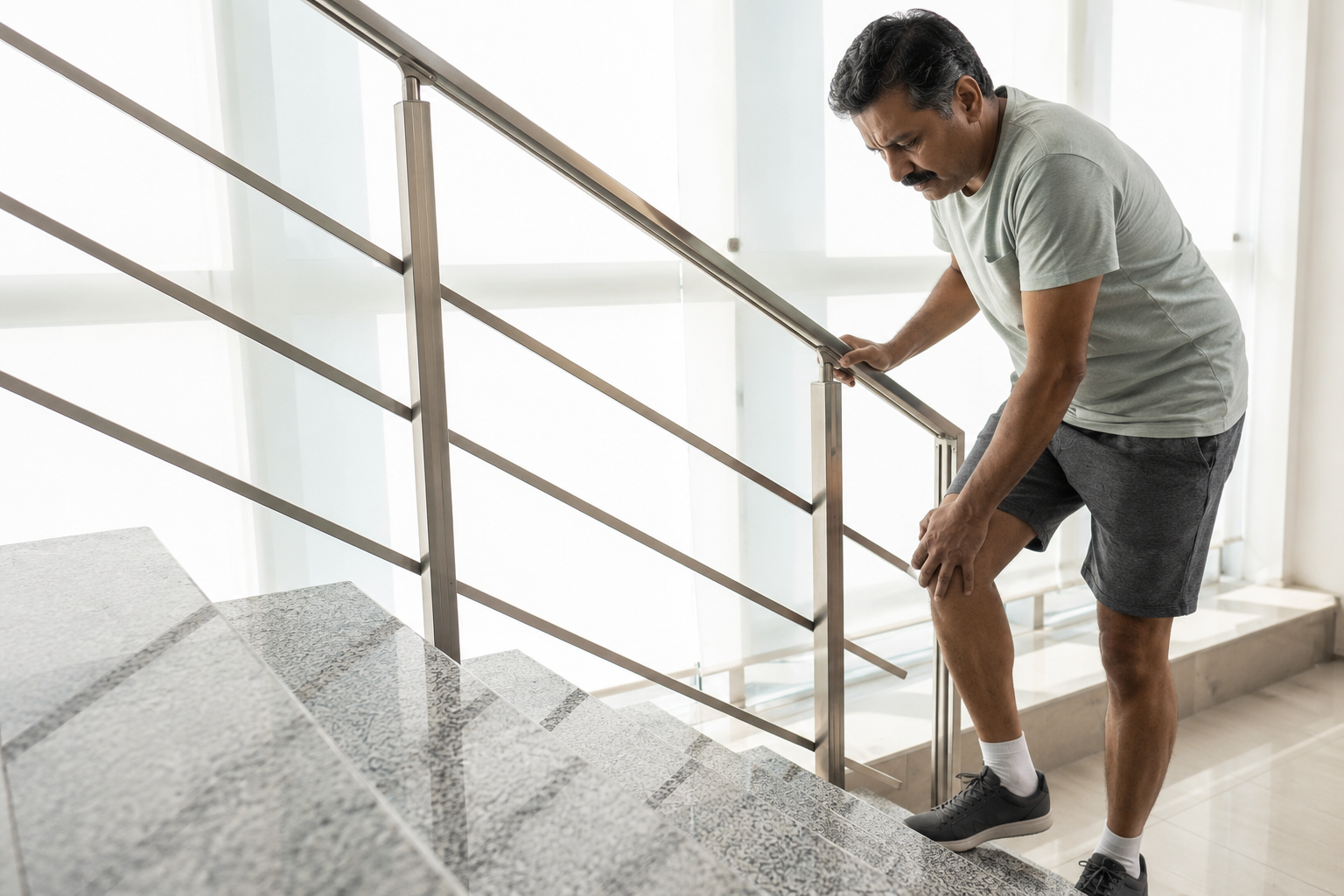
Have you ever noticed your knees feel fine while walking on flat ground, but hurt when climbing stairs? You're not alone. Knee pain while climbing stairs is one of the most common complaints among adults — especially adults over 40, working professionals, active adults, gym-goers, people with arthritis, and those recovering from injuries.
For some people it feels like sharp pain. For others it's stiffness or weakness. Sometimes the discomfort is mild. Sometimes it becomes frustrating enough to affect daily movement, office life, workouts, and confidence climbing stairs. Naturally, many people start wondering "why is this happening?" — or even "does this mean I have arthritis?"
The good news is that knee pain while climbing stairs does not automatically mean something serious. But it also should not always be ignored, because pain while climbing stairs may sometimes be an early signal that something needs attention. In this guide, we'll explain why knees hurt climbing stairs, common causes, when to worry, treatment options, whether surgery is necessary, and how non-surgical treatments may help.
Why Do Knees Hurt Climbing Stairs?
Knees may hurt while climbing stairs due to arthritis, muscle weakness, cartilage wear, tendon irritation, kneecap alignment issues, injuries, inflammation, or joint stress. Climbing stairs increases pressure on the knee joint, which can make underlying problems more noticeable.
The reason stairs hurt more than normal walking is simple: stairs place significantly more load on your knees. When going upstairs, your knee joint works harder. If there is inflammation, weakness, arthritis, cartilage stress, or poor movement mechanics, pain may become more noticeable.
Why Does Stair Climbing Trigger Knee Pain?
Many patients ask "why does it hurt only when climbing stairs?" Here's why: when climbing stairs, the knee experiences greater pressure, deeper bending, and increased force. This means small underlying issues become more obvious — especially if muscles are weak, joints are irritated, cartilage is stressed, or inflammation exists. Stairs often expose problems that normal walking may not.
Common Causes Of Knee Pain While Climbing Stairs
1. Arthritis (Very Common After 40)
One of the most common reasons, especially among adults over 40 and over 50. Arthritis may affect joint cushioning, flexibility, and movement comfort.
- Stiffness
- Pain while climbing stairs
- Discomfort after sitting
- Swelling and cracking sounds
Many people ask "does stair pain mean arthritis?" Sometimes, but not always — only proper evaluation can determine this. Explore Arthritis Treatment Chennai.
2. Weak Muscles Around The Knee
One of the most overlooked causes. Weak thigh muscles, hips, glutes, and calves may increase pressure on knees — very common among working professionals, sedentary adults, and remote workers. Long sitting may weaken support muscles, which makes stairs harder.
3. Patellofemoral Pain (Runner's Knee)
Sometimes pain happens around the kneecap area, often feeling worse during stairs, squatting, or sitting long hours. Common among active adults, runners, and gym-goers.
4. Tendon Irritation
Repeated stress may irritate tissues around the knee, often due to overtraining, jumping sports, or repetitive movement. Pain may feel sharp or movement-triggered.
5. Cartilage Wear & Tear
Sometimes cartilage changes affect movement comfort. This may gradually worsen over time, especially in adults over 40.
6. Sports Injuries
Old injuries may sometimes become more noticeable during stairs, including ligament strain, overuse injuries, and instability. Explore Sports Injury Treatment Chennai.
Working Professional Knee Pain: Why Office Workers Often Feel Stair Pain
This is extremely common. Many professionals tell us "my knees hurt only after work." Long sitting may contribute to muscle weakness, stiffness, and reduced mobility — especially for people who sit 8–10 hours, drive long distances, or rarely move during the workday. A common search we see is "why do my knees hurt after sitting?"
Can Knee Pain While Climbing Stairs Heal Without Surgery?
In some cases, yes. Knee pain while climbing stairs may improve through non-surgical treatment depending on the cause, severity, and diagnosis. Weakness, inflammation, early arthritis, movement issues, and some injuries may sometimes respond to conservative treatment approaches. Not every patient needs surgery — treatment depends on diagnosis, severity, joint health, lifestyle, and activity level.
When Should You Worry About Stair Pain?
Consider specialist evaluation if:
- Pain lasts more than a few weeks
- Swelling develops
- Walking becomes difficult
- Knee feels unstable
- Stairs become increasingly painful
- Stiffness worsens or movement reduces
Early evaluation often means more treatment options.
Treatment Options For Knee Pain While Climbing Stairs
The right treatment depends on what is actually causing the pain. Not every knee pain problem needs the same approach. At Apex Wellness Co, treatment plans are personalized.
1. Orthopedic Evaluation
Everything starts with understanding why the knee hurts. An orthopedic assessment helps evaluate pain location, movement patterns, stiffness, swelling, joint function, and mobility limitations — because treating symptoms alone often leads to temporary relief.
2. Physiotherapy & Rehabilitation
In many cases, movement matters — especially when weakness contributes to stair pain. Rehabilitation may help improve knee stability, flexibility, muscle support, movement confidence, and stair comfort. This is particularly helpful for working professionals, sedentary adults, post-injury recovery, and early-stage movement problems. Explore Physiotherapy & Rehabilitation Chennai.
3. Strengthening Weak Supporting Muscles
Sometimes the knee itself is not the real problem. Weak quadriceps, hips, glutes, and calves may increase stress on the knee joint. Improving muscle support may sometimes reduce discomfort during stairs, squatting, walking, and standing.
4. Lifestyle & Movement Changes
Small habits matter more than many people realize. Taking movement breaks, improving mobility, avoiding long inactivity, and reducing unnecessary joint stress may help long-term outcomes, especially for working professionals.
5. Regenerative Medicine Approaches: Can PRP Help Knee Pain While Climbing Stairs?
One of the most common questions we hear is "can PRP help my knee pain?" In selected orthopedic cases, PRP therapy may sometimes be explored as part of a non-surgical treatment plan for knee pain depending on diagnosis, joint condition, and medical suitability.
PRP therapy stands for Platelet-Rich Plasma Therapy. It uses concentrated platelets from your own blood and may sometimes be explored in selected cases involving knee pain, arthritis-related discomfort, tendon irritation, and sports-related recovery. PRP is not suitable for everyone, and it does not replace surgery in every situation — the decision depends on diagnosis, severity, and joint health. Explore PRP Therapy Chennai.
Does Stair Pain Mean You Have Arthritis?
Not always. While arthritis is one common cause, other reasons may include weakness, tendon irritation, muscle imbalance, kneecap tracking issues, sports strain, and inflammation. That said, if stair pain is happening with stiffness, swelling, cracking sounds, and reduced flexibility, then arthritis may sometimes be worth evaluating, especially after age 40.
How To Protect Your Knees While Climbing Stairs
Simple habits may help reduce knee stress.
- Strengthen supporting muscles — especially thighs, glutes, and hips
- Avoid sudden overload — jumping into intense activity suddenly may worsen discomfort
- Stay active — movement matters, but correct movement matters more
- Don't ignore recurring pain — persistent stair pain deserves evaluation, especially if symptoms worsen
- Address pain early — the earlier the root cause is understood, the more treatment options may be available
Key Takeaway
Knee pain while climbing stairs is common and doesn't automatically mean arthritis or surgery. Stairs place more load on the knee joint, which can make underlying issues like weakness, tendon irritation, or early cartilage wear more noticeable. Understanding the root cause early often means more treatment options — including physiotherapy, strengthening, and regenerative approaches like PRP.
Frequently Asked Questions About Knee Pain While Climbing Stairs
Why do knees hurt climbing stairs?
Knees may hurt due to arthritis, muscle weakness, tendon irritation, cartilage wear, kneecap stress, or injuries.
Is knee pain while climbing stairs serious?
Not always. But recurring pain should be evaluated.
Does stair pain mean arthritis?
Sometimes, but not necessarily.
Why does my knee hurt only on stairs?
Stairs place more pressure on knees than normal walking.
Can knee pain while climbing stairs heal naturally?
Some causes may improve with conservative treatment depending on severity.
Why does knee pain happen after sitting too long?
Long sitting may contribute to stiffness and weakness.
Can weak muscles cause stair pain?
Yes. Weak muscles may increase pressure on knees.
Can physiotherapy help stair pain?
In many situations, rehabilitation may help improve movement and support.
Can PRP therapy help knee pain?
Selected orthopedic cases may sometimes be evaluated for regenerative approaches.
Why do knees crack while climbing stairs?
Joint movement, stiffness, or wear may sometimes contribute.
Is walking good for knee pain?
Depends on diagnosis.
Why do knees hurt after age 40?
Joint wear, arthritis, reduced mobility, and weakness may contribute.
Should I avoid stairs completely?
Not always. Movement guidance depends on diagnosis.
Why does one knee hurt more than the other?
Movement patterns, weakness, or prior injuries may play a role.
Can sports injuries cause stair pain?
Yes. Old injuries may sometimes contribute.
Can sitting all day worsen knee pain?
Sometimes, yes.
What exercises help stair pain?
Exercises depend on the cause and should ideally be guided.
Can weight affect knee pain?
Additional joint stress may contribute.
How long does recovery take?
Depends on diagnosis and treatment plan.
When should I see a specialist?
Persistent pain, swelling, stiffness, or movement limitations should be evaluated.
Expert Perspective: At Apex Wellness Co, one of the most common things we hear is "my knees only hurt while climbing stairs." Many people assume it's probably normal, but recurring pain is often your body asking for attention. The goal is not panic — the goal is to understand the cause early, because treatment options may be wider when problems are identified earlier.
Unsure Why Your Knees Hurt Climbing Stairs?
A personalized orthopedic evaluation may help you understand what may be causing pain, whether arthritis is involved, whether non-surgical options may help, and how to improve long-term mobility.
Book Consultation →